
2. About us
About Us
The Caribbean Digital Transformation Project (CARDTP) in Saint Vincent and the Grenadines is a government-led initiative, financed by the World Bank. This project is part of a broader effort that includes similar transformations in three other Organisation of Eastern Caribbean States (OECS): Dominica, Grenada, and St. Lucia. The CARDTP aims to enhance government efficiency and transparency through the digitization of internal operations.
Key objectives include:
- The digitization and streamlining of government operations to improve transparency and effectiveness.
- Improve public access to government services through digitization.
- 24/7 online access to government services.
- National digital skills development.
- Online infrastructural development.
The components of CARDTP:
CARDTP comprises eight (8) Technical Working Groups (TWGs)
- Vincy Single Window for Trade Facilitation (VSWIFT)
- Single Window for Land Property Transactions (SWLPTs)
- E-Government Infrastructure and Operations.
- Citizen Authentication and Digital Unique Identifier.
- Data Protection and Privacy.
- Cybersecurity
- E-Payment Platform
- E-Tax
3. FAQs
FAQs
The Caribbean Digital Transformation Project is being implemented in the Commonwealth of Dominica, Grenada, St. Lucia and St. Vincent and the Grenadines as well as the OECS Commission, have received funding from the IDA for the implementation of the CARDTP. The total cost of the project is US$94 million, including a grant of US$8.0 million to the OECS Commission.
The Financing Agreement between the Government of St. Vincent and the Grenadines and the World Bank was signed on July 29, 2020 in the amount of US$30 million and the project became effective in November 2020.
To increase access to digital services, technologies and skills by governments, businesses, and individuals in the participating Eastern Caribbean countries.
All the islands are unique in nature hence there is a national component but in order to foster integration given the OECS Economic Union the project is coordinated at the regional level through a Regional Project Implementation Unit (RPIU) at the OECS Commission. Regional project components with direct impact at the national level are implemented by the OECS Commission, the ECCB, ECTEL and CARICOM IMPACS.
The OECS Commission now will lend technical support to the islands in the implementation of the project and at the local level the Project Implementation Unit with the help of the OECS Commission will implement the different components locally.
There are eight working groups in total. They are:
- Citizen Authentication- Digital ID
- E-Government Infrastructure and Operations
- Single Window for Land and Property Transactions
- Single Window for Customs Transactions
- E-Payment
- E-Tax
- Cybersecurity
- Data Protection and Privacy
- Response to disease pandemics, man-made and natural disasters and economic shocks.
- Continuity of government operations
- Enabling remote work and learning
- Reducing physical contact, travel and waiting times
- Enhanced economic diversification
- Strengthen the enabling environment for digital financial services
- Development and supply of digitally enabled services and skills to a global marketplace
- Reduced waiting times, allows for more productive time to be spent on an economic activity of your choice.
- Enhance cybersecurity capability against cyber-attacks and fraud - public and private sector
- Enhance resilience and emergency response of critical communications infrastructure.
Digital transformation is not perfect it does have its drawbacks. The drawbacks are:
- It often requires organizational change. Therefore, it is not always easy to implement, as it requires planning, effort and support.
- There is usually resistance to change. Employees and managers often resist changes especially if they are not planned and stakeholders are not involved at the beginning of the change process.
- It requires a large investment
There are Global, Regional and National imperatives driving digital transformation –
Digital technologies (ICTs – telecommunication networks, devices and applications) are changing global economy affecting almost every sector and aspect of our lives. Our countries and region cannot be left behind. Digital transformation is therefore critical to recognizing economic opportunities and sustainable livelihoods.
UN SDG 9 – calls for building resilient infrastructure, fostering innovation and universal access to ICTs
Specific National Drivers
National Economic and Social Development Plan calls for economic diversification, human capital development, building climate resilience and improving efficiency of the public sector.
Improving our overall environment for doing business efficiently, a major driver for attracting foreign direct investment.
Promote the delivery of 24/7 anytime/anywhere delivery of government services.
Measuring Digital Transformation is not always easy as the objectives will vary from one organization to another. As a result, different metrics will be required. Nevertheless, metrics such as productivity, number of users and customer satisfaction can be measured against predefined KPIs.
THE PROJECT STEERING COMMITTEE
The Project Steering Committee was appointed by Cabinet to provide overall guidance and oversight for the Caribbean Digital Transformation Project (CARDTP). The Project Steering Committee is comprised as follows:
Ministry of Finance, Economic Planning and Information Technology- Director General, Finance and Planning (Chairman)
Economic Planning Department- Director of Economic Planning
Treasury Department- Accountant General
Customs and Excise Department- Comptroller
Information Technology Services Department- Director
Inland Revenue Department- Comptroller
Ministry of Health etc. – Permanent Secretary
Ministry of Transport, Works, Land and Physical Planning- Permanent Secretary
Ministry of National Security etc.- Permanent Secretary
Ministry of Legal Affairs- Hon. Attorney General
Registry, High Court
Ministry of the Public Service, etc. – Permanent Secretary
Commerce and Intellectual Property Office- Registrar
CARDTP Project Implementation Unit- Project Coordinator/ Manager
The role of the Project Steering Committee is to:
- Assess project progress;
- Provide advice and guidance on issues facing the project;
- Assist with resolving strategic-level issues and risks;
- Use influence and authority to assist the project in achieving its outcomes.
Responsibilities of the Steering Committee Chair
The Steering Committee Chair is the Director- General- Finance and Planning. The responsibilities of the Steering Committee Chair are to:
- Set the agenda for each meeting.
- Ensure that agenda and supporting materials are delivered to members in advance of meetings.
- Make the purpose of every meeting clear to members and explains the agenda at the beginning of each meeting.
- Clarifies and summarizes what is happening throughout each meeting.
- Keep the meeting moving by putting time limits on each agenda item and keeping all meetings to two hours or less.
- Encourages broad participation from members in the discussion by calling on different people.
- End each meeting with a summary of decisions and assignments.
- Follow up with consistently absent members to determine if they wish to discontinue membership.
Responsibilities of Steering Committee Members
- Individual Steering Committee members have several responsibilities. He/ She must:
- Understand the goals, objectives and desired outcomes of the project.
- Ensure that the project is making prudent decisions- especially in procurement and responding to issues, risks and proposed project changes.
- Ensures that the project remains aligned with the strategy, policies and directions across the government.
- Understand and represent the interests of project stakeholders.
- Take a genuine interest in the project’s outcomes and overall success.
- Act on opportunities to communicate positively about the project.
Project Implementation Unit
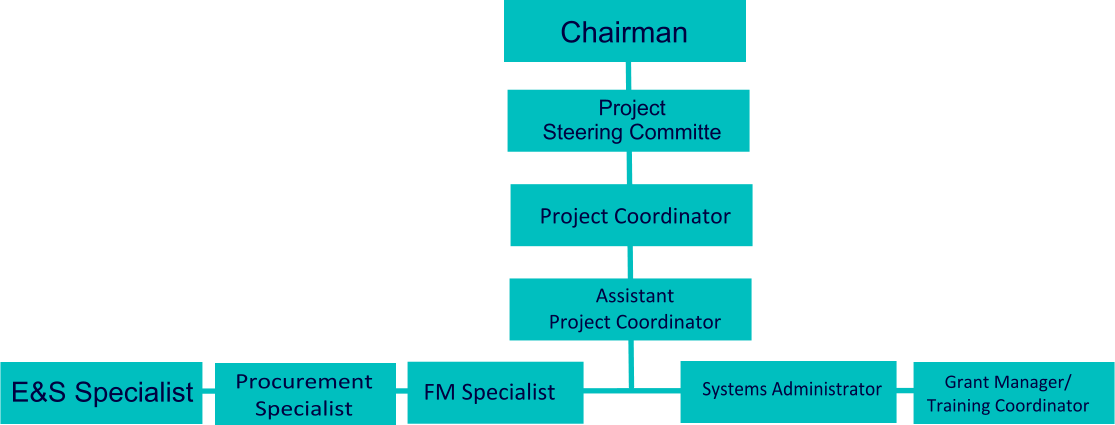
The Project Implementation Unit (PIU) consists of the Project Coordinator, Assistant Project Coordinator, Procurement Specialist, Environment and Social Specialist, Financial Management Special and Grant Manager/ Training Coordinator, Systems Administrator. The implementation unit role is to work along with the Technical Working Groups and the Technical Advisory Firm to ensure that the project is implemented successfully. The Technical Advisory Firm is that firm (s) that will provide support to the PIU for procurement preparation, contract management, capacity building and related functions.
Members:
Chairman – Mr. Edmond Jackson
Project Coordinator- Mr. Winston George
Assistant Project Coordinator- Mr. Anson Latchman
Systems Administrator- Mrs. Lizanna Williams Henry
Grant Manager/ Training Coordinator - TBD
FM Specialist- Ms. Keisha Gonsalves
Procurement Specialist- Mrs. Janelle Quow
Procurement Specialist- Ms. Stacey Browne
TECHNICAL WORKING GROUPS AND THEIR ROLES
The Technical Working Groups were formulated by the members of the Project Steering Committee. A total of eight (8) Technical Working Groups were established. The overall mandate of the working groups is to assist with the implementation of the different components of the project.
However, there are specific works to be carried out under the different working groups. The Citizen Authentication and Digital ID working group is responsible for reconciling births and deaths, creating a population registry and establishing a single multipurpose unique Identification Card.
This multipurpose Identification Card will be the heart and soul of the new system as it will provide the necessary credentials to access all of the government services. The project also has a Customs Single Window for Trade Transaction working group and a Single Window for Land and Property Transactions.
The prior has the mandate of creating a one stop shop that is interoperable and financially sustainable for customs trade transactions while the latter is tasked with creating a one stop shop that is interoperable and financially sustainable for land and property transactions, a parcel based land information system.
There is also an E-Government Infrastructure working group which has the responsibility of integrating the different ministries and departments seamlessly. Moreover, the streamlining of business processes to enhance efficiency and drive greater cost savings.
Citizens should be able to pay for government services and file for taxes at any time from any remote location. Thus, to facilitate this need two working groups emerged. They are E-Payment and E-Tax. The E-Payment working group will establish a digital platform to enable digital payments thereby reducing time and costs. On the other hand, the E-Tax working group will provide the necessary mechanism necessary for persons to file for taxes and make tax payments online.
The environment in which the government services will operate needs to be regulated and legal. Thus, a Data Protection and Privacy working group was established to craft the regulatory and legal framework for protecting citizen’s data, it’s usage and access.
Additionally, the new systems will be of no value if they are not secured. Therefore, securing the government’s infrastructure is of utmost importance. The Cybersecurity working group will be responsible for establishing the necessary protection of systems, networks, programs and all infrastructure from digital attacks which are aimed at accessing, altering or destroying sensitive information. Outlined below are the different working groups.
1. Vincy Single Window for Trade Facilitation (VSWIFT)
Members:
- Customs and Excise Department- ASYCUDA Coordinator- Lead
- Ministry of Trade
- Bureau of Standards
- ITSD
- Ministry of Agriculture- Plant Protection & Quarantine and Animal Health
- Chamber of Industry and Commerce
- St. Vincent and the Grenadines Port Authority
- Inland Revenue Department
- Project Coordinator, CARDTP
3. E-Government Infrastructure and Operations
Members:
- ITSD- Lead
- Customs and Excise Department (ASYCUDA Admin)
- Accounting Division (Treasury-SIGFIS Admin)
- Inland Revenue Department- (SIGTAS Admin)
- Civil Registry- Systems Administrator
- Immigration Office- Systems Administrator
- Ministry of Health- Systems Administrator
- Land and Surveys- GIS/IT Representative
- Ministry of Housing- GIS/Town Planner
- Project Coordinator, CARDTP
5. Data Protection and Privacy
Members:
- ITSD-Lead
- SVG Police Force
- Internet Society Representative
- Legal Affairs
- NTRC
- Project Coordinator, CARDTP
7. E-Payment
Members:
- Treasury
- CIPO
- Chamber of Industry and Commerce
- National Insurance Services
- Inland Revenue Department
- Customs and Excise Department
- NTRC
- ITSD
- Legal Affairs
- Project Coordinator, CARDTP
2. Single Window for Land Property Transactions
Members:
- Lands and Surveys- Lead
- Civil Registry
- GIS Unit, Ministry of Housing
- Chief Surveyor
- Ministry of Housing- Town Planner
- Valuation Unit, IRD
- ITSD
- Legal Affairs
- Project Coordinator, CARDTP
4. Citizen Authentication and Digital ID
Members:
- Civil Registry – Lead
- Ministry of Health
- Electoral Office
- Immigration Office
- ITSD
- Legal Affairs
- Project Coordinator
6. Cybersecurity
Members:
- ITSD-Lead
- SVG Police Force
- Internet Society Representative
- Legal Affairs
- NTRC
- Project Coordinator, CARDTP
8. E-Tax
Members:
- Treasury
- CIPO
- Chamber of Industry and Commerce
- National Insurance Services
- Inland Revenue Department
- Customs and Excise Department
- NTRC
- ITSD
- Legal Affairs
- Project Coordinator, CARDTP